
Table of Contents
The scorching summer heat has arrived, and with it comes the ultimate dread for every household: the massive electricity bill. Running air conditioners and coolers non-stop can easily drain your monthly budget.
However, a massive update from the government has changed the game entirely. You might have heard the viral news about getting 300 units of free electricity every single month.
This is not a rumor; it is a reality made possible by the PM Surya Ghar Muft Bijli Yojana. This government initiative is taking the country by storm, especially in Uttar Pradesh.
But with viral news comes a lot of dangerous misinformation. Are the solar panels completely free? What is the hidden catch that local dealers are hiding from you?
In this comprehensive guide on Aavaz, we will break down the absolute truth behind the PM Surya Ghar Muft Bijli Yojana. We will explore the exact math, the double subsidy for UP residents, and the complete application process.
What Exactly is the PM Surya Ghar Muft Bijli Yojana?
The PM Surya Ghar Muft Bijli Yojana is a highly ambitious central government initiative aimed at reducing the electricity burden on middle-class households. It promotes green energy by encouraging citizens to install rooftop solar panels.
By participating in the PM Surya Ghar Muft Bijli Yojana, households can generate their own clean electricity right from their roofs. The core promise of this scheme is to provide up to 300 units of free electricity per month to eligible families.
This not only helps you achieve a zero electricity bill but also contributes to a cleaner environment. The government provides massive financial assistance directly to your bank account to make this setup affordable.
However, understanding the financial mechanics of the PM Surya Ghar Muft Bijli Yojana is crucial before you make any decisions. It is not as simple as placing an order and getting a free delivery of solar panels.
The Biggest Myth: Are the Solar Panels 100% Free?
Let us address the elephant in the room and bust the biggest myth circulating on WhatsApp groups. The solar panels provided under the PM Surya Ghar Muft Bijli Yojana are not distributed for free.
The name of the scheme promises “Muft Bijli” (free electricity), not free solar equipment. You must first invest your own money to purchase and install the rooftop solar system.
You need to hire a government-approved local vendor to set up the system at your house. Once the installation is complete and the electricity department approves it, the magic happens.
Under the rules of the PM Surya Ghar Muft Bijli Yojana, the government will then transfer a heavy subsidy amount directly into your registered bank account. This refund drastically reduces your actual investment.
The Jackpot: Double Subsidy Benefits in Uttar Pradesh
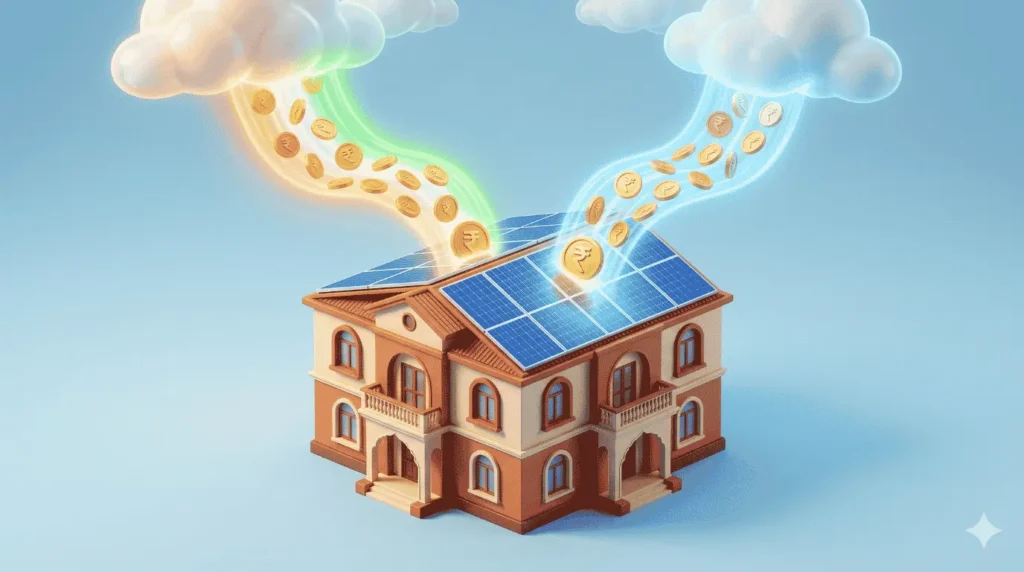
If you live in Uttar Pradesh, especially in districts like Bijnor or Seohara, you have hit the solar jackpot. The UP state government is offering a “Double Subsidy” to boost the PM Surya Ghar Muft Bijli Yojana.
This means you get money from Prime Minister Modi’s central government, plus extra money from Chief Minister Yogi Adityanath’s state government. This dual benefit slashes the installation cost in half.
Most people are completely unaware of this state-level bonus. Let us look at a detailed breakdown of how much money you can actually save under the PM Surya Ghar Muft Bijli Yojana in UP.
Estimated Cost and Subsidy Table for UP Residents
| Solar Plant Capacity | Average Total Cost | Central Govt Subsidy | UP State Govt Subsidy | Total Subsidy You Get | Your Final Net Cost |
| 1 kW | ₹ 55,000 | ₹ 30,000 | ₹ 15,000 | ₹ 45,000 | Approx. ₹ 10,000 |
| 2 kW | ₹ 1,10,000 | ₹ 60,000 | ₹ 30,000 | ₹ 90,000 | Approx. ₹ 20,000 |
| 3 kW | ₹ 1,65,000 | ₹ 78,000 | ₹ 30,000 | ₹ 1,08,000 | Approx. ₹ 57,000 |
(Note: The total cost may slightly vary based on the quality of panels and the specific vendor you choose in your local area.)
As you can clearly see, a 3 kW system is the “sweet spot” of the PM Surya Ghar Muft Bijli Yojana. You get a massive combined discount of ₹1,08,000, bringing a heavy ₹1.65 lakh investment down to just around ₹57,000!
The Hidden Catch: What Solar Dealers Will Never Tell You
Transparency is key when making a long-term investment. While the PM Surya Ghar Muft Bijli Yojana is incredibly beneficial, there is a technical reality you must know.
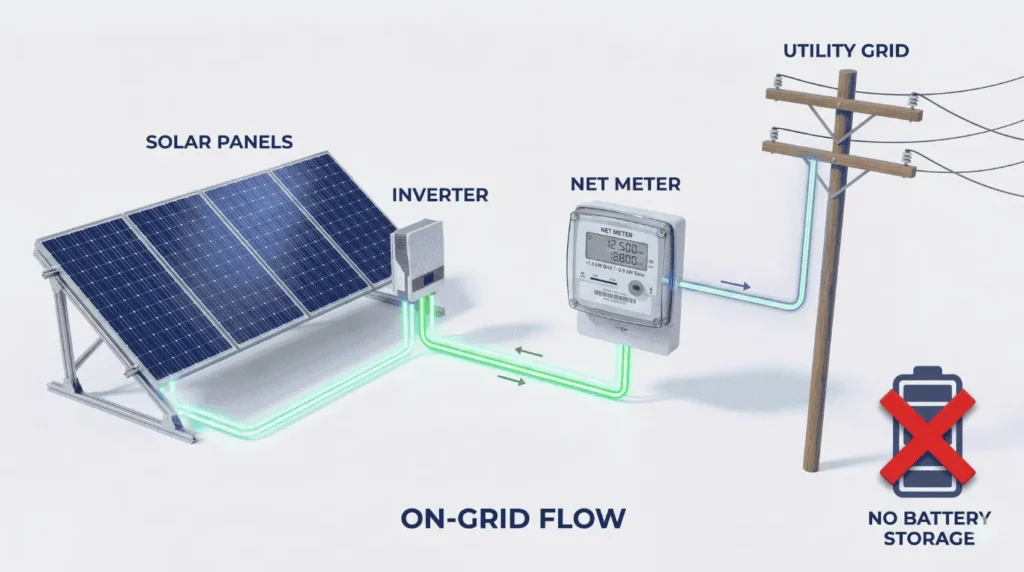
The solar setups approved under this scheme are strictly “On-Grid” systems. This means they do not come with large battery banks to store power for the night.
Because it is an on-grid system, your solar panels are directly connected to the UPPCL government power lines. This brings us to the biggest catch of the PM Surya Ghar Muft Bijli Yojana.
If the government power grid shuts down due to a local power cut, your solar panels will also instantly stop producing electricity. Yes, even in the bright afternoon sun, your solar plant will turn off.
This happens due to a safety feature called “Anti-Islanding”. If your panels kept sending electricity into the wires during a power cut, the lineman repairing the fault could get a fatal electric shock.
Therefore, to survive daily power cuts, you will still need your traditional home inverter and battery setup. The PM Surya Ghar Muft Bijli Yojana is designed to save your billing money, not to provide off-grid backup.
How Net Metering Zeros Out Your Bill
If there are no batteries, how do you get free electricity at night? The answer lies in a brilliant technology called “Net Metering.”
When you enroll in the PM Surya Ghar Muft Bijli Yojana, the electricity department replaces your normal meter with a new bidirectional Net Meter. This meter reads power going both in and out of your house.
During the sunny hours, your solar panels produce high amounts of electricity. Your home appliances consume this free energy first.
Any extra electricity that your house does not use is immediately exported to the government grid. The net meter records exactly how many units you gave to the government.
At night, since the sun is down, your house imports electricity from the government grid just like before. At the end of the month, the billing calculation is simple.
If you took 200 units from the government at night, but gave them 250 units during the day, your final bill is exactly zero. The extra 50 units you produced under the PM Surya Ghar Muft Bijli Yojana are carried forward to the next month!
Are You Eligible? A Quick Checklist
Before you start planning your rooftop installation, you must confirm your eligibility. The government has set strict criteria for the PM Surya Ghar Muft Bijli Yojana.
Not everyone can simply apply and claim the one lakh rupee subsidy. Please go through this simple checklist to see if you qualify:
- Permanent Resident: You must be an Indian citizen residing in the country.
- Concrete Roof: You must have your own house with a concrete (pucca) roof. Tenants or those living in rented apartments cannot apply.
- Valid Electricity Connection: The electricity meter and the recent bill must be strictly in the name of the applicant.
- Aadhaar Linking: Your Aadhaar card must be securely linked to your mobile number and your primary bank account.
- No Prior Subsidy: You must not have availed of any other government solar subsidy for the same property in the past.
If you tick all these boxes, you are a perfect candidate for the PM Surya Ghar Muft Bijli Yojana.
Documents Required for Application
Applying for government schemes requires precise paperwork. To ensure your application is not rejected, gather your documents beforehand.
Keep these documents scanned and ready on your mobile phone or laptop before applying for the PM Surya Ghar Muft Bijli Yojana:
- Recent Electricity Bill: Must be from the last 6 months, clearly showing your consumer account number.
- Aadhaar Card: Must belong to the exact person whose name is on the electricity bill.
- Bank Account Proof: A clear photo of a canceled cheque or your bank passbook. This is where your subsidy will arrive.
- Passport Size Photograph: A recent, clear photograph of the applicant.
- Rooftop Photograph: A wide-angle picture of your empty roof where the solar panels will be installed.
Having these documents ready will make your PM Surya Ghar Muft Bijli Yojana application process incredibly smooth and fast.
Step-by-Step Online Application Process
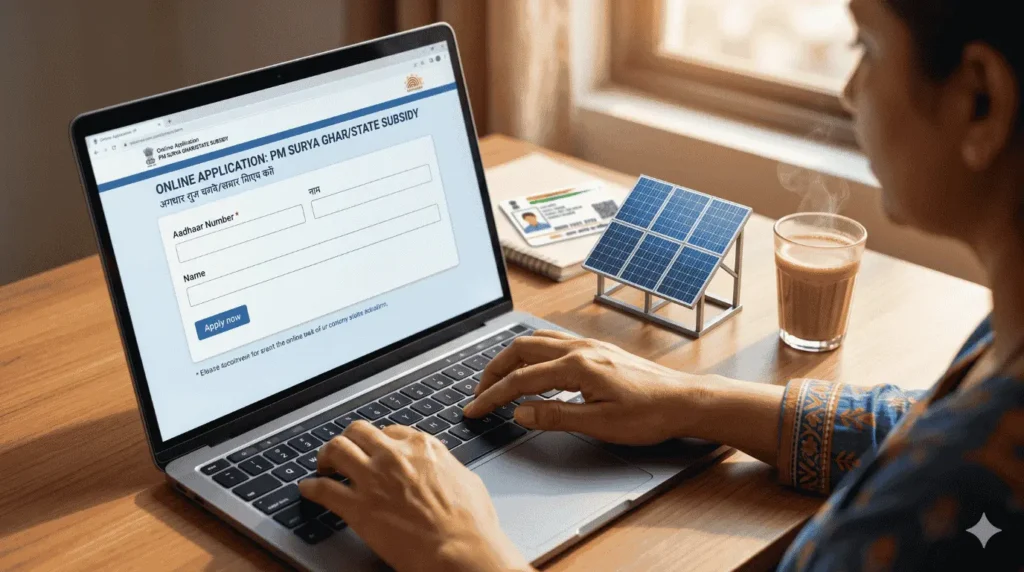
You do not need to pay any agents or visit government offices to apply. The PM Surya Ghar Muft Bijli Yojana features a completely digital application process.
Follow this step-by-step guide to submit your application safely from your mobile phone or computer:
Visit the Official Portal:
Open your web browser and go exactly to the National Portal at pmsuryaghar.gov.in. Do not click on fake WhatsApp links.
Initial Registration:
Click on the “Apply for Rooftop Solar” button. Select your state (e.g., Uttar Pradesh) and your electricity distribution company (like UPPCL).
Enter Consumer Details:
Type in your exact electricity consumer number (Account ID) as printed on your bill.
OTP Verification:
Enter your active mobile number and email ID. Verify your account using the OTP sent to your phone.
Fill the Main Form:
Log back into the portal using your consumer number. Open the PM Surya Ghar Muft Bijli Yojana application form and fill in all requested details.
Upload Documents:
Upload the scanned copies of your electricity bill, bank passbook, and roof photographs. Submit the form.
Wait for Feasibility Approval:
Your local electricity department (SDO office) will verify your application. You must wait for their online “Feasibility Approval” before spending any money.
Select Your Vendor:
Once approved, you can select a registered solar vendor from the portal’s authorized list to install the plant.
Claim Your Subsidy:
After installation, the vendor will arrange for the net meter installation. Once the meter is live, the PM Surya Ghar Muft Bijli Yojana subsidy will hit your bank account within 30 days.
Why You Must Choose an Approved Vendor
One of the biggest mistakes people make is buying cheap solar panels from unauthorized local shops. This is a massive financial risk.
To get the subsidy under the PM Surya Ghar Muft Bijli Yojana, it is absolutely mandatory to get the installation done only through a registered vendor.
Registered vendors use government-certified ALMM (Approved List of Models and Manufacturers) standard panels. They also provide a mandatory 5-year maintenance warranty.
If you use a non-registered installer, your application will be permanently rejected. You will not receive a single rupee of the PM Surya Ghar Muft Bijli Yojana subsidy.
We highly recommend contacting authorized dealers in the Bijnor and Seohara areas who have a proven track record of successful net-metering installations.
The Long-Term Financial Impact
Installing a solar plant is not just about the immediate subsidy; it is about securing your future. Electricity tariffs are guaranteed to rise every year.
By taking advantage of the PM Surya Ghar Muft Bijli Yojana today, you are locking in your energy costs for the next 25 years.
High-quality solar panels have a lifespan of over two decades. The ₹57,000 you invest today for a 3kW plant will be recovered through zero bills within just 1.5 to 2 years.
After that recovery period, you are essentially enjoying completely free air conditioning, refrigeration, and lighting for the next 23 years. This makes the PM Surya Ghar Muft Bijli Yojana the best financial investment you can make for your home.
Common Application Mistakes to Avoid
Many applicants face delays in their subsidy disbursement due to silly errors. Here is how to ensure your PM Surya Ghar Muft Bijli Yojana process is flawless.
Never apply with an electricity bill that is not in your name. If the house is in your father’s name, the application must also be in his name.
Ensure your bank account name perfectly matches your Aadhaar and electricity bill name. A single spelling mistake can freeze your PM Surya Ghar Muft Bijli Yojana subsidy transfer.
Do not pay the full amount to the vendor before the net meter is successfully installed and activated by the electricity department.
Conclusion
The PM Surya Ghar Muft Bijli Yojana is a revolutionary step toward making India energy-independent at the household level. It offers a permanent escape from the anxiety of summer electricity bills.
While the upfront cost might seem challenging, the combined double subsidy from the central and UP governments makes it incredibly affordable.
Remember, knowledge is your best defense against fraud. Understand the reality of on-grid systems, follow the application steps carefully, and only trust authorized vendors.
If you found this guide helpful, share it with your friends and family so they can also save their hard-earned money. Keep reading Aavaz for more such verified and actionable financial guides.
Frequently Asked Questions (FAQs)
Q1. Are the solar panels completely free under the PM Surya Ghar Muft Bijli Yojana?
No, the panels are not free. You have to pay the initial installation cost to the vendor. The government will later deposit a massive subsidy into your bank account as a refund.
Q2. What is the maximum subsidy I can get in Uttar Pradesh?
For a 3 kW setup, you can get a central subsidy of ₹78,000 and an additional UP state subsidy of ₹30,000. This brings the total maximum subsidy to ₹1,08,000 under the PM Surya Ghar Muft Bijli Yojana.
Q3. Will my solar panels provide electricity during a UPPCL power cut?
No. Because this is an “on-grid” setup, the panels automatically shut down during a grid power cut to protect linemen from electric shocks. You will need your home inverter for power backup.
Q4. Can I apply if I live in a rented house?
No. The PM Surya Ghar Muft Bijli Yojana strictly requires the applicant to have their own concrete roof and the electricity meter must be registered in their own name.
Q5. How long does it take for the subsidy to arrive in my bank account?
After the solar plant is installed and the electricity department successfully activates your net meter, the subsidy is usually credited to your bank account within 30 working days.
Author Box

Name: Anwar Hashmi
Role: Chief Editor, Aavaz.in
Bio: Anwar Hashmi is an entrepreneur and the Chief Editor of Aavaz.in. With a deep focus on financial literacy, government policies, and digital awareness, he simplifies complex economic and social issues for the common man. Based in Seohara, Bijnor, he is dedicated to bringing fearless journalism and actionable insights to his readers.